Why a Journey Feels Different When the Route Has a Shape
A journey route with a line, loop, or landscape sequence gives travel a readable rhythm, helping you choose what to notice between departure and arrival.
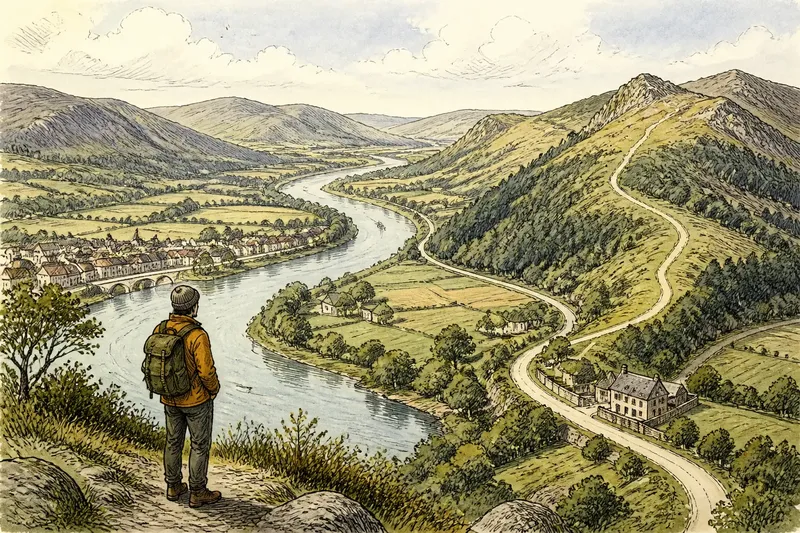
The common mistake in planning a journey route is to draw a straight line between the places you already know you want to visit. It gets you there, but it can make the ground in between feel like an errand. Give the route a shape—a river’s bend, a ridge, a coast, or a sequence of changing landscapes—and the passage itself begins to matter.
What does a route’s shape change?
A route shape is not a decorative line on a map. It is a simple organizing idea that influences what you pass, how the scenery changes, and where you naturally pause. A line may follow a river upstream; a loop may return by a different valley; a sequence may move from farmland to foothills to high country.
That idea gives the journey a rhythm without requiring a packed schedule. You can travel slowly through one stretch, stop where the landscape opens, then cover a less distinctive connection without guilt. The route has a subject, and you know what to look for.
This also changes the role of the endpoint. A harbor, town, or mountain pass still matters, but it is no longer the only part of the journey with a claim on your attention. The route is not merely the space between two pins.
Which shape suits the journey?
A line works when a feature has a clear direction: a river, a valley, a coastal edge, or a chain of towns along one road. It gives the day a sense of movement toward something, while allowing small variations along the way. Keep the line flexible enough to leave the main road for a viewpoint or a village that fits the landscape you are following.
A loop suits places where the return can offer a different view rather than simply retrace the outward leg. A loop through a basin, peninsula, or broad valley can make geography easier to read: the outward journey reveals one side, and the return shows how it relates to the other. Check that the loop is genuinely distinct, not a longer way of seeing the same roadside.
A sequence is useful when the point is change rather than direction. You might arrange the day around water, woodland, and open upland, or move from a sheltered harbor to exposed headland. The transitions do the work. A sequence can be especially satisfying on foot or by local bus, where the shift in terrain is felt at human pace.
These shapes are prompts, not contracts. If a road closure, weather, or a good conversation alters the plan, the underlying idea can still hold. Following a valley does not require treating every bend as an obligation.
How do you make a route readable?
Start with one feature you can trace on an ordinary map: a river, ridge, shoreline, or change in elevation. Then look at a topographic map, a local transit map, or an atlas with enough detail to show settlements and connecting roads. Satellite imagery can help clarify whether a line on paper follows a footpath, a busy road, or a barrier such as a river with few crossings.
- Mark the anchor feature. Draw or highlight the river, coast, valley, or ridge that gives the journey its direction.
- Note the transitions. Look for bridges, passes, forest edges, and changes in slope where the landscape may feel different.
- Choose a few natural pauses. A village, trail junction, overlook, or sheltered shore gives the route places to breathe without turning it into a collection exercise.
- Check the connection between sections. Confirm that roads, paths, and public transport actually join the places you intend to link.
- Leave a loose margin. Keep space for a slow stretch or an unplanned stop; the route’s shape should guide attention, not dictate every minute.
Say you are planning a day around a river valley, with a small town at the upstream end. You mark the river, choose a downstream village as a pause, and check a map for a bridge that allows a return by the other bank. The expected result is a journey that reveals the valley from more than one angle, rather than a drive to town and back along the same road.
For access, closures, and transport connections, check the relevant local information before setting out. A map can describe the shape of the land; it cannot promise that a particular gate or service is open.
What questions help you choose a route shape?
Is a linear route better than a loop?
Neither is inherently better. A line is often clearer when the landscape has a strong direction, while a loop earns its place when the return shows a meaningfully different side of the area.
How many stops should a shaped route include?
Use enough pauses to notice changes in the landscape, not enough to turn every marked place into a deadline. A few well-spaced stops usually leave more room to observe than a string of brief arrivals.
Can a route have a shape in a city?
Yes. Follow a canal, a line of parks, a slope from an upper neighborhood toward the waterfront, or a sequence of streets with changing building styles. The shape can come from the city’s terrain or pattern, not only from countryside.
What if the weather changes the plan?
Keep the route’s central feature, but adapt how you encounter it. A river can still organize a journey from a sheltered path or a nearby town when an exposed ridge is an unwise choice.
What is not worth forcing?
Do not bend a journey around a shape that looks elegant on a map but makes the practical connections awkward. A loop that depends on an uncertain crossing, or a scenic line that leaves no comfortable pause, is less useful than a modest route with a clear beginning and a sensible return.
Nor is every landscape change worth naming as a grand progression. Sometimes the useful observation is simply that the road follows the water, then climbs away from it, and later returns. That is enough structure to make the day legible.
A journey route with a shape can be small: one valley road, a different way back, or a walk that follows the edge between town and open land. Choose the feature you want to follow, then let the pace respond to what it reveals. The destination will still be there at the end; the route gives the rest of the day something to say.